Switching jobs? The maths shows that preserving your pension is much smarter
24 June 2025
The Living Annuity Masterclass: How to maximise your retirement income


When you change jobs, you have three options:
(1) Leave your money in your previous employers' pension or provident fund, and thereby lose control of where your money is invested for the long run and the fees you pay (two factors that could significantly influence how much money you have for retirement)
(2) Cash in your savings (yikes! We'll discuss why this is the worst option for your retirement further down), or...
(2) Transfer your retirement savings to a preservation fund to protect and grow your savings.
According to various industry surveys, between 70% and 80% of employees choose the cash out route. While one can empathise with this inclination – we all face a whole range of challenges in today’s economy - when you consider the maths involved, it might appear short-sighted. Younger employees are especially at risk, because they believe they have the time to make up this dip into their pension - but they don’t.
A quick recap: What is a preservation fund?
A preservation fund is a retirement savings vehicle that allows you to transfer your funds across from a pension or provident fund when changing jobs. This allows you to preserve your retirement savings. Your savings can then continue to potentially grow and accumulate over the long term, eventually providing for your retirement years.
You can transfer your pension or provident savings to a preservation fund without any tax obligation. You should, however, make sure that a provident fund is transferred to a provident preservation fund and that a pension fund is transferred across to a pension preservation fund.
See your pension savings grow with our
Preservation Fund calculatorThis ensures you have control over your investments. You can choose to invest your retirement savings in a range of underlying funds. The fund you choose will depend on your financial needs, risk tolerance levels and time horizons. This control is important: it's your retirement, and you should be able to choose how the money your save for that retirement is invested.
However, the most important thing to consider is fees: what will you be paying to keep your capital invested?
High fees can eat away at returns and therefore negatively effect the growth of your capital. And small fee differences today make a huge difference over time, because just as returns compound for you over time, fees compound against you. You should always understand your Effective Annual Cost (EAC), and then compare that against other providers. You can use the handy EAC calculator here to do just that.
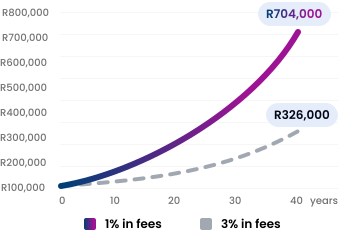
Here are some calculations to show you the cumulative effect of the difference between a 2% fee and a 0.7% fee on a preservation fund of R500,000 over 25 and 30 years. These examples assume stable returns of 10% per year, with 'all other things being equal'. We have not factored inflation into the mix.
Over 25 years, the maths looks like this:
- At a 2% fee or 8% growth: R500,000 \times (1.08)^{25} = R3,424,223
- At a 0.7% fee or 9.3% growth: R500,000 \times (1.093)^{25} = R4,625,290
That's a difference of R1,201,067
Over 30 years, due to the increased time for compound interest to work on higher numbers, the difference is even more painful:
- At 2% fees or 8% growth: R500,000 \times (1.08)^{30} = R5,031,328
- At 0.7% fees or 9.3% growth: R500,000 \times (1.093)^{30} = R7,215,119
The difference is a whopping R2,183,791
Now that you understand what even small differences in fees can mean for your retirement, here's more on why preserving retirement savings is always the smart choice (as you've already done the most important part of the heavy lifting!).
After ten years of saving, you’re almost halfway there!
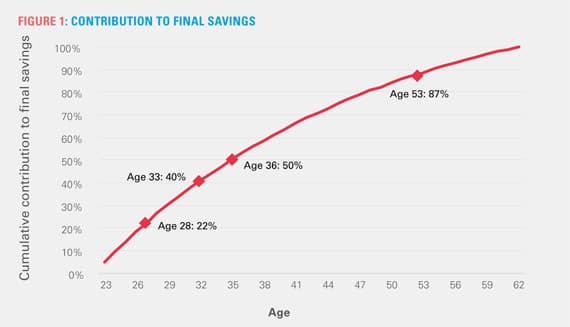
In a diligent forty-year savings plan, the first two years’ contributions already pay for 10% of your retirement. By the time you hit 36, you have already funded half your pension – provided you leave this money alone. By contrast, the last ten years’ contributions make up only 13% of your pension. The bottom line is to save as much as you can as early as you can, and then leave your money alone. Cashing out in your thirties will cost you half of your pension. If you want to skip ten years of saving, rather skip the last ten years, and not the first.
Catching up is hard to do
You may believe that you can catch up by saving more in the future. But in reality, this is harder than you might think. Most people already struggle to save at the recommended rate of 15% per annum. If you cash in your retirement savings after ten years, you would have to save 25% of your income for the subsequent 30 years to make up the shortfall. Not only is that a big bite out of your lifestyle, but only just below the 27,5% tax-deduction limit. Delay for another two years, and you won’t even be able to claim your required contributions for tax. And if you delay until your forties, you will have to save half your income to make up the shortfall.
Starting late cheats you out of your money working hard for you
Cashing in early and starting over not only affects the percentage of income you need to save in order to reach your goal; it also cheats you out of your money working for you. The shorter your savings period, the less your pot grows by way of investment returns, and the more of your pension must be funded by only what you put away. So if you decide to cash in your pension after ten years, you don’t just lose what you have saved, but also the return you would have earned on those savings, compounding for thirty years and beyond. That is a lot of money to lose out on - money that you didn’t even have to work for.
Speak to a knowledgeable human about your retirement
We understand that making the right decision for your retirement can feel like a daunting task. If you're feeling overwhelmed, chat to one of our experienced investment consultants at no cost to you, and with no obligations. We've been helping thousands of South Africans retire better for over a decade, and there are no call centres at 10X, just experienced humans happy to help.
Related articles


How can we 10X Your Future?
Begin your journey to a secure future with 10X Investments. Explore our range of retirement products designed to help you grow your wealth and achieve financial success.